An open-source browser cloud built for scale, security, and performance.
Browser fleets scale from 10 to 10,000 pods, with a live view designed for phones. Touch, typing, gestures, and reconnection make remote sessions feel like a local browser.
Built the regional fleet and mobile viewer together, keeping browsers warm for fast allocation and adding capacity as demand grows. Sessions combine end-to-end encryption, confidential hardware, and hardware attestation for a verifiable browser environment.
An iPhone, a projector, and a wall that plays back.
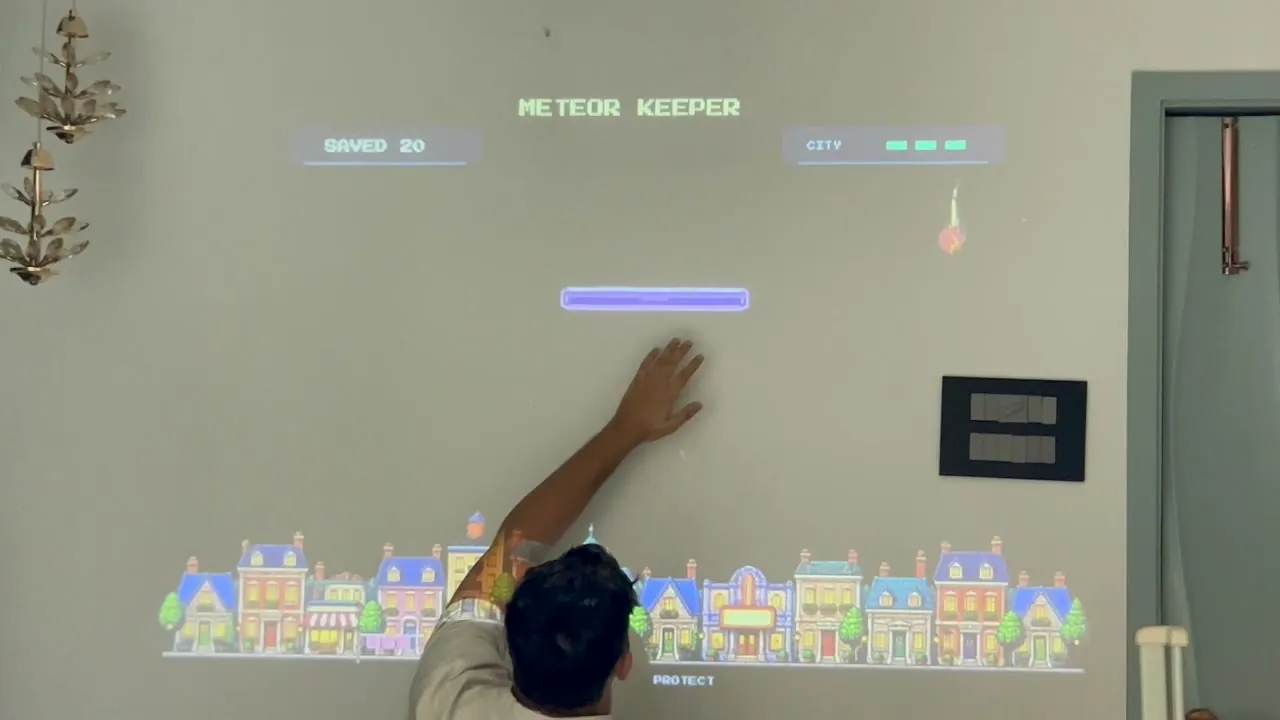
A spatial computing experiment that turns a wall into games controlled by your hands. Defend a city, cook imaginary soup, or draw in the air. The phone tracks your hands and runs the game; the projector brings it into the room.
Meteor Keeper, one of the games in the playground.
The goal was to make AI agents faster and cheaper to run, while reducing the need to test every change by hand.
An autoresearch harness automates experiments, compares models and approaches, and uses measured results to fine-tune smaller models. Repeatable checks measure task completion, cost, and speed, giving the next experiment a clear direction.
An AI-powered API for sentiment and emotion analysis in video.
Built with college friends for a competition, Sentilytics combines video frames, audio, and transcripts to understand a clip from multiple angles. It captions scenes, detects facial emotions, tracks people across the timeline, and analyzes sentiment in speech and text.
A Flask API and React interface bring the results together, using OpenCV and FFmpeg for video processing, TensorFlow models, and IBM Watson for speech-to-text.